Job Introduction
Driving Standards Manager
Lincolnshire Fire and Rescue (LFR) has more than 400 blue‑light response trained drivers based at 38 fire stations across Lincolnshire.
Most are Category C licence holders trained to drive a range of fire appliances and large fleet vehicles. Some are blue‑light response car drivers, and some hold both accreditations.
The Role
The Driving Standards Manager (DSM) is a non‑operational role, based at LFR’s Waddington Training Centre.
The post holder manages a small team of driving instructors who, together with the DSM, deliver training to new response drivers and provide ongoing assessment and re‑accreditation for existing drivers. Day‑to‑day work includes managing instructors and learners attending courses, planning and arranging training programmes, and coordinating vehicles, facilities and associated administration.
The role also includes responsibility for the professional management of driving instructors, including workload oversight, authorising leave, supporting development needs and ensuring consistency and standardisation through peer assessment and quality monitoring.
Training delivery and professional development
The DSM is expected to deliver training personally and will either hold, or be willing to achieve, the required qualifications. This includes the DVSA Approved Driving Instructor (ADI) qualification and completion of the National Fire Chiefs Council (NFCC) Emergency Response Driving Instructor (ERDI) pathway.
This is a structured development route, involving external courses and a circa three‑year pathway to full accreditation while working in post. Where a suitable candidate does not yet meet all qualification requirements for the full role, LFR may consider appointment at one grade below, with a structured development plan and progression to the substantive grade on successful completion of the required qualifications.
The training delivery aspect of the role involves teaching advanced emergency response driving techniques, including the lawful use of speed limit exemptions for sustained periods. Applicants should already have experience in this specialist area or have a clear understanding of the risks and demands involved.
Governance, compliance and assurance
The DSM is responsible for ensuring that driver training across the Service remains legally compliant, safe and effective. This includes maintaining alignment with legislation, national and regional best practice, National Fire Standards, Department for Transport and DVSA doctrine, and NFCC Emergency Response Driver Training requirements.
The role includes responsibility for maintaining and developing driver training policies, procedures and quality assurance arrangements, ensuring that LFR’s approach to emergency response driving is robust, auditable and consistently applied.
A key part of the role is maintaining accurate records and assurance data, including response driver competence, re‑assessment and renewal dates, and instructor portfolios, providing confidence to the Service that driving standards are effectively managed and monitored.
Professional advice and stakeholder working
The DSM acts as the Service’s subject matter expert for all aspects of driving, providing professional advice and guidance to managers and instructors on standards, licensing, compliance and good practice.
This includes advising the Service on matters such as collision investigations, driver licensing, and legal or regulatory issues associated with driving activities.
The role involves strong links with other training functions within Fire and Rescue, regular engagement with staff across 38 stations, and close working with fleet, risk and other managers. The post holder will also represent LFR at regional and national meetings and work collaboratively with other fire and rescue services, as well as partners in the ambulance and police sectors.
Resources, data and working patterns
The post holder will be responsible for a six‑figure training budget, including ongoing training needs analysis and identifying future budget requirements.
Producing reports, managing spreadsheets and using modern data analysis tools are an important part of the role, alongside strong interpersonal and communication skills.
The role requires some flexibility, with availability to deliver occasional evening and weekend training, typically around one evening and one weekend per month.
Working environment and values
The DSM is line managed by the Operational Training Manager and works within Lincolnshire County Council’s values and ways of working, contributing to continuous improvement, efficiency and safe service delivery across LFR.
The role is customer‑focused and recognises that many learners will have primary employment outside the Fire Service, reflecting the Service’s reliance on on‑call Firefighters, who form the majority of course attendees.
Please note interviews are due to take place across 30th April and 1st May
Data Collection:
All application and selection data will be collected and reviewed to ensure a fair process and to identify areas where additional support may be necessary.
Reasonable Adjustment Requests:
For candidates with neuro-divergence and disabilities, the process will operate a system of reasonable adjustments to those applicable parts to enable these candidates’ full access to the process whilst ensuring that the assessment process remains valid with all candidates receiving an equitable assessment experience.
For the applicable parts of the assessment process, LFR will mirror the IFE position for Reasonable Adjustments to provide continuity and clarity. Although reasonable adjustments must not compromise the validity and reliability of examination results, they should be based on individual needs and reflect the ways in which affected candidates normally work. Applications for reasonable adjustments should be made clear on the application form.
Alternatively, please contact Recruitmentfire@lincolnshire.gov.uk to discuss further.
Disclosures and Barred Services:
Please be advised that the Rehabilitation of Offenders Act 1974 now includes the requirement for Fire and Rescue Service employees to have a standard DBS check as a minimum. This legislation change applies to all Fire Services across the country and the process aims to help safeguard colleagues and communities. This role will require an enhanced DBS check.
As a service we are committed to safeguarding and promoting the welfare of children, young people and vulnerable adults and expect all staff and volunteers to share this commitment.
All candidates are advised to read the attached job information pack prior to making an application.
On occasion we receive significantly more applications than expected for some vacancies and under such circumstances we reserve the right to bring forward the closing date of the advertisement. We therefore strongly advise you to apply for the role promptly to avoid disappointment should the closing date be brought forward.
Please note: once an application is submitted it is final and cannot be amended. If you withdraw your application, it cannot be reinstated and you will not be able to submit another application for that vacancy.
We operate a talent pool scheme whereby candidates who are not successful on this occasion may be considered for a period of up to 3 months for equal positions.
Fluency Duty
In accordance with Part 7 of the Immigration Act 2016 (Fluency Duty), the ability to converse at ease with customers and provide advice in accurate spoken English is essential for the post.
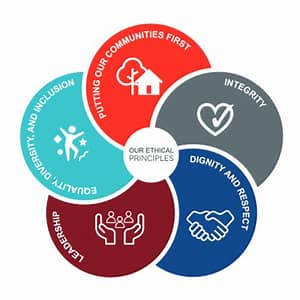
We’re looking for candidates who align with our values- Putting communities first, Integrity, Dignity and Respect, Leadership, Equality Diversity and Inclusion.